
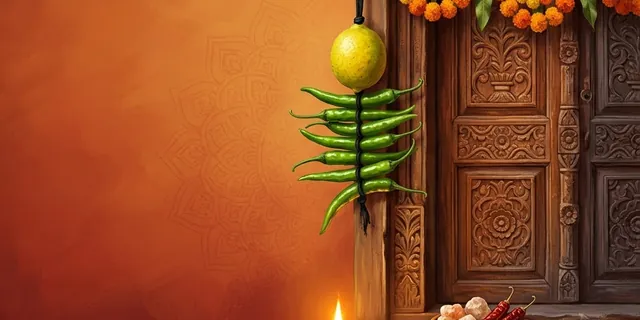
Nazar utaarna with mustard and salt
Traditional belief: removes the effect of the evil eye.
Updated: 21 October 2026
In short
- Take a fistful of mustard seeds and salt.
- Pass it seven times around the person, clockwise.
- Discard it in running water or the drain.
When a baby who was happy all day suddenly cries without stopping, or a child who looked lovely at a wedding comes home tired and unwell, many Indian grandmothers have the same explanation: nazar lag gayi, someone's eye has fallen on them. And they have the same answer: nazar utaarna, a small ritual to take the evil eye away. This article explains the belief, the common ways it is done, and how to keep it safe.
What nazar means
Nazar (also called drishti in South India) is the belief that admiration mixed with envy, even from someone who means no harm, can bring bad luck, illness or tiredness to the person admired. Babies and young children, brides and grooms, a new house or vehicle and a business that is doing well are thought to be the most exposed, because they draw the most attention.
The belief is old and widespread, far beyond India: the evil eye is known across West Asia, the Mediterranean and Latin America, each with its own charms. In India the most familiar protection is the small black kajal dot (dithona) put behind a baby's ear or on the forehead, so that the child is not "perfect" and the eye passes over. When protection fails, nazar is "taken off".
The mustard and salt method
The most common method in North India uses rai (black mustard seeds) and salt:
- Take a small fistful of mustard seeds and salt together in the right hand. Some families add a few dried red chillies.
- Let the person sit comfortably, facing you. For a baby, a parent can hold them.
- Move your closed hand in circles around the person's head and body, from head to toe, seven times. Most families move clockwise; some go anticlockwise. Many recite a short prayer or the name of their family deity while doing it.
- Without looking back, take what is in your hand out of the house and throw it away: traditionally into running water, at a crossroads, or into a drain.
- Wash your hands.
Other common methods
- Red chillies: a few dried chillies are passed around the person and then dropped into a fire or onto a hot pan. Many families say that if the chillies burn without the usual sharp smell, it was nazar.
- Alum (phitkari): a piece of alum is passed around and put on a flame; the shape it melts into is "read".
- Lemon: a lemon is passed around the person, cut in four and thrown away outside.
- Kajal: a dot of kajal behind the ear or on the sole of the foot, mostly as prevention.
Keep it safe
- Never burn chillies indoors or near a baby, a person with asthma or an older person. Burning chillies releases capsaicin into the air, which causes severe coughing and can trigger breathing problems. If you follow this method, do it outside, away from people, and keep children away from the smoke.
- Keep kajal away from a baby's eyes. Many traditional kajals contain lead, which is harmful to children; doctors advise not to apply kajal to babies' eyes at all.
- Do not throw salt and mustard where it can harm plants, animals or a water source used for drinking.
When it is not nazar
A child who cries a lot, refuses feeds, has a fever, vomits, has loose motions or seems unusually sleepy needs a doctor, not only a ritual. The same is true for an adult who is suddenly unwell. There is nothing wrong with doing nazar utaarna for comfort, but please do it as well as, never instead of, taking the person to a doctor when they are ill. For many families the real value of the ritual is the moment of care: an elder's hand moving gently around the child, and a prayer for their wellbeing.
Astrology and totke are traditional beliefs, offered for guidance and interest. Nuskhe are home remedies and are not medical advice; see a doctor for any health concern.